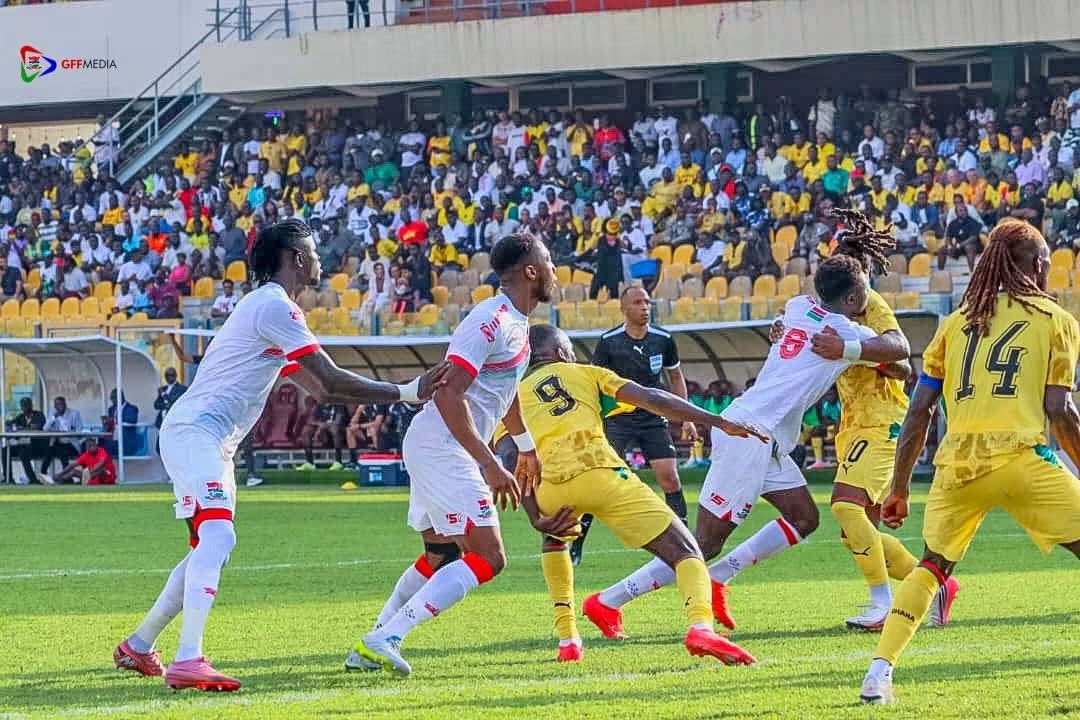
The Scorpions of The Gambia exceeded their wildest dreams to overturn a 2-0 deficit to secure an unlikely, stunning 4-2 win against the Black Stars of Ghana in front of a stunned home crowd at the Accra Sports Stadium in round two of the 2027 AFCON qualifiers. It appears as if it was going to be a long afternoon for coach Johnathan McKinstry and his side when Ghana took a 2-0 lead after 33 minutes with a penalty from Ernest Nuamah and a free kick from Felix Afena-Gyan.But how the Scorpions turned the game on its head to grab maximum points is one thing that left Ghana in total bewilderment. A rally with a converted penalty by Muhammed Badamosi, a close-range finish by captain Omar Colley and a brace from substitute Ebrima Colley were enough to send disbelief across the footballing family in Ghana and earned The Gambia a second straight win.But this wasn't a difference in class and maturity. This could only be credited to one thing - tactical discipline. TACTICAL MASTERCLASS BY JOHNNY MCKINSTRY The Northern Irish man deployed a five-man defensive approach with Omar Colley, Yaya Bojang, Alagie Saine, Joseph Ceesay, and Ibou Touray, all accustomed defenders starting.That wasn't packing the bus. It was a game plan. The approach worked against Somalia, where the Scorpions recorded a 2-1 victory, but this time around, it brought along an even bigger result.The approach prevented Ghana from scoring in open play. If not for the penalty and a free kick that looked more like a gift from goalkeeper Babucarr Gaye, who wrongly positioned the wall and himself, the score was going to be even more embarrassing for the home side.Even with the five defenders, Ibou Touray and Joseph Ceesay were largely seen joining the attack when the Scorpions were in possession, with the combative Portsmouth man Ebou Adams covering the gaps at the back when necessary. That helped the team draw themselves back on level terms at 2-2 before half-time. The biggest turning point came in the second half when the Scorpions tactician added left-back Sainey Sanyang and midfielders Mouhamadou Drammeh and Ebrima Colley and forward Adama Bojang in the positions of midfielders Abubakr Barry, Suleiman Camara, Abdoulie Sanyang and striker Mohammed Badamosi. Not only did Ebrima Colley score two goals, but the way they helped the team maintain a clear balance between defence and attack and how Sainey, Mouhamadou and Ebrima combined in the lead-up to the 4th goal, justified how right those tactical switches were. All through the game, the Scorpions were tactically mature, disciplined, and they stayed true to their approach from start to finish. FLURRY OF GOALS Knowing fully well that losing to the Scorpions would be considered unforgivable, the Black Stars started the show in the 27th minute when Ernest Nuamah converted from the penalty spot following a foul by Badamosi. 3 minutes later, Felix Afena-Gyan curled home a free kick from outside the 18-yard box.At the moment, Ghanaians, from supporters to the Football Association President, the belief was that it was an afternoon of redemption. But the way the Scorpions rallied was astonishing. Mohamed Badamosi reduced the deficit from the spot in the 37th minute following a foul on Abdoulie Sanyang by captain Gedeon Mensah in the box.With 3 minutes to halftime, the Scorpions were levelled. Captain Omar Colley hit home a flick from fellow centre-back Yaya Bojang following a long throw from left-back Ibou Touray in the 42nd minute. After the break, the Black Stars were desperate for a win, attacking the Scorpions at every presentable chance. They were caught unawares at the back twice when the Scorpions switched gear to hit them on a quick break. In the 68th minute, Mohamed Badamosi flicks a long looping ball in the path of substitute Ebrima Colley, who hit past Benjamin Asare in the Ghana goalpost. And on the stroke of regulation time, the Scorpions hit the final nail into the Ghanaian coffin as Ebrima Colley headed home a Sainey Sanyang's cross into an unguarded net. The result sent a total shockwave and uproar among the home crowd, who angrily called for the resignation of the Portuguese boss Carlos Queiroz and Kurt Okraku, the President of the Ghana Football Association. A WORTHLESS DIFFERENCE The difference between the Black Stars and the Scorpions is like a gap between a beginner and a professional. The Black Stars, who are currently ranked 65th in the world, have played in five World Cups and reached the quarter-finals in 2010. They managed four Africa Cup of Nations titles in their 24 appearances in the competition and also won seven WAFU titles. These achievements will make anyone believe that Ghana should not be any match for the Scorpions. This difference was rendered worthless as they were humbled before their home crowd. The Scorpions of The Gambia are ranked 116th globally and have only appeared in the AFCON twice, in 2021 and 2023, finishing in the 2021 quarter-finals as their best feat without ever playing in the World Cup. But the recent form of the Scorpions is unmatched by that of Ghana. In 12 consecutive games, the Scorpions won 7, drew 1, and lost 4, as opposed to Ghana, who have won just one, lost 9 and drawn 2 in 12 straight outings now. This simply shows how football is played and won not by size, achievements, or history, but on form and perhaps a bit of luck. WHAT NEXT? This victory puts the Scorpions in pole position to qualify for the 2027 AFCON after they missed out on the last edition. If they can grab six points out of a possible 12 in their remaining four games, qualification will certainly be secured.For the Black Stars, their destiny squarely lies in their own hands. They must grab a minimum of 10 points out of a possible 12 in their next four games to stand even the slightest of chances.For now, they will first need to diagnose their problem and start working on it; perhaps a possible return of Mohammed Kudus, Antoine Semenyo, and Jordan Ayew in the next window could be a possible solution. That, though, remains to be seen!
Continue Reading >>